

This post is also available in:
Hello Valleggianti!
Today we’re diving into one of those things you can’t really understand unless you’ve experienced it at least once.
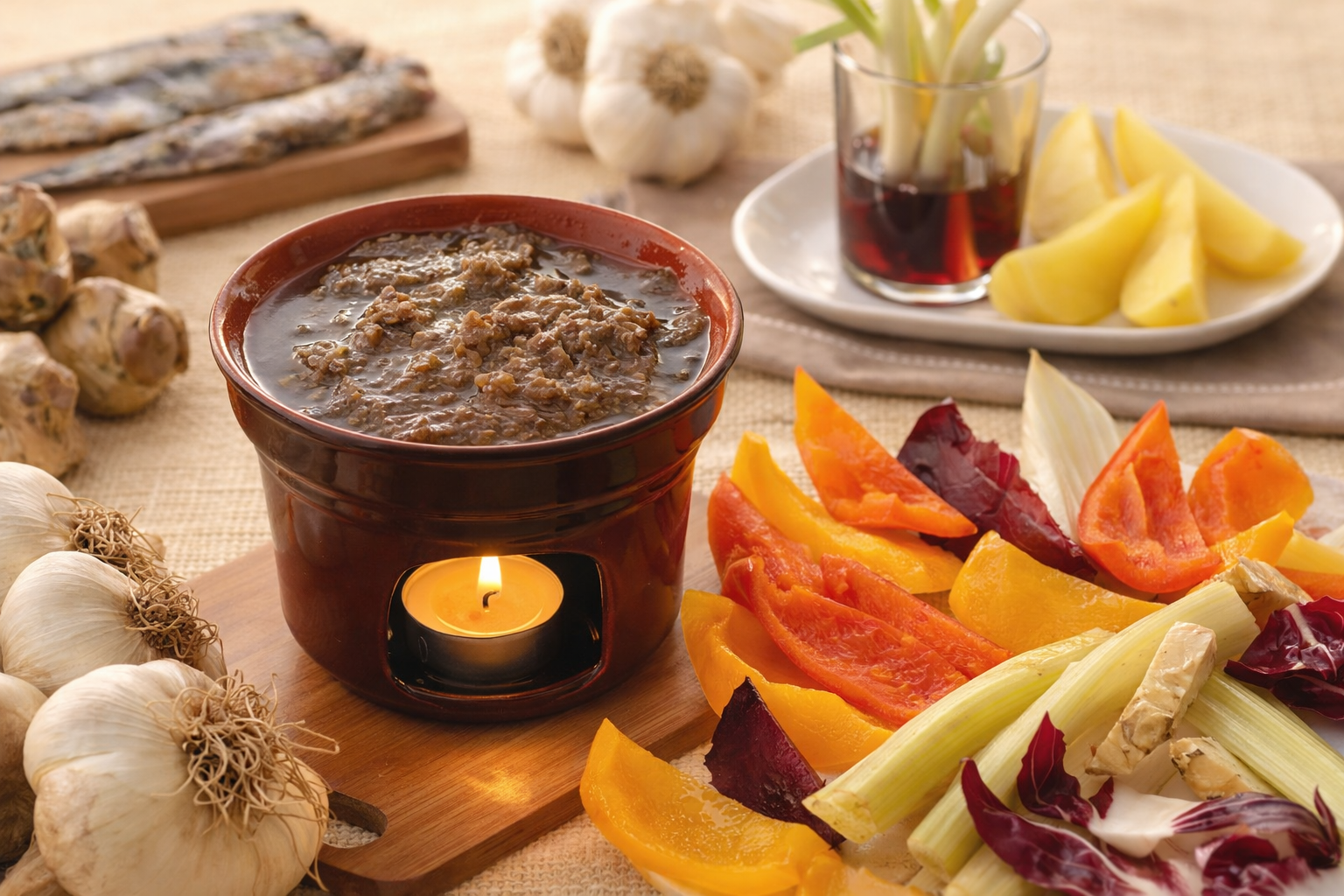
Because bagna caoda (pronounced cauda) is not a dish. It’s a way of being. It’s a way of coming together.
Bagna caoda: where it all begins
There are evenings when time changes rhythm without us really noticing.
It happens when someone says “let’s make bagna caoda.”
And from there, slowly, everything shifts.
The table extends, the chairs draw closer, the words become longer too.
Bagna caoda was born this way, in lower Piedmont, as a harvest dish, when work in the fields ended and people finally sat down together. It wasn’t a luxury, it wasn’t something refined, but it was something that filled you—not just your stomach, but the very act of being together.
And perhaps that’s exactly why, even today, every time it arrives at the table, it always feels like coming home.
Anchovies and anchovy traders: the sea that crosses the mountains
If you think about it, bagna cauda is a paradox.
A dish of the land that exists thanks to the sea.
The anchovies weren’t from here.
They arrived.
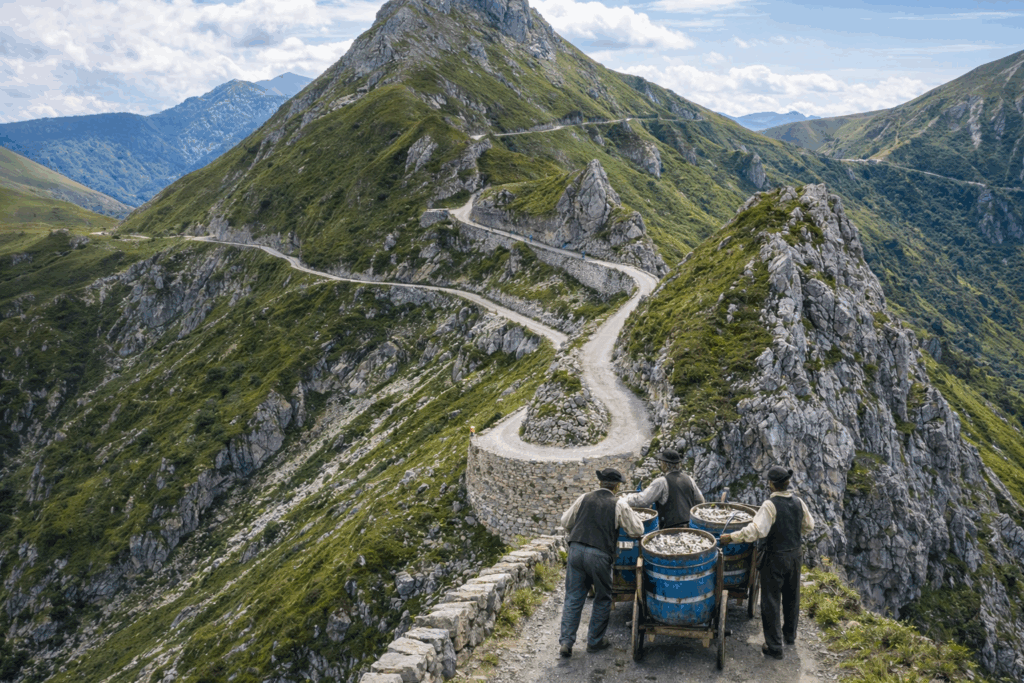
They crossed the Alps along the salt routes, inside barrels, on carts, carried by the acciugai—figures who seem to belong more to a story than to reality.
They were men in constant travel, going up and down the valleys, carrying something precious with them.
And not just for the flavor.
Because beneath those anchovies was salt, and salt was wealth, was control, was trade.
In fact, it’s said they were used to hide salt, to avoid the heavy taxes imposed on the trade of this spice.
And then you understand that inside that warm pot there’s not just a recipe.
There’s a passage.
There’s a journey.
You can learn more about the history of anchovies here:
Here you can read my article dedicated to the Salt Route:
The Salt Route, Land of Exchange, Trade, and Great Value
The vegetables: the land that offers itself
Then they arrive.
The vegetables.
Which are not a side dish.
They’re part of the story.
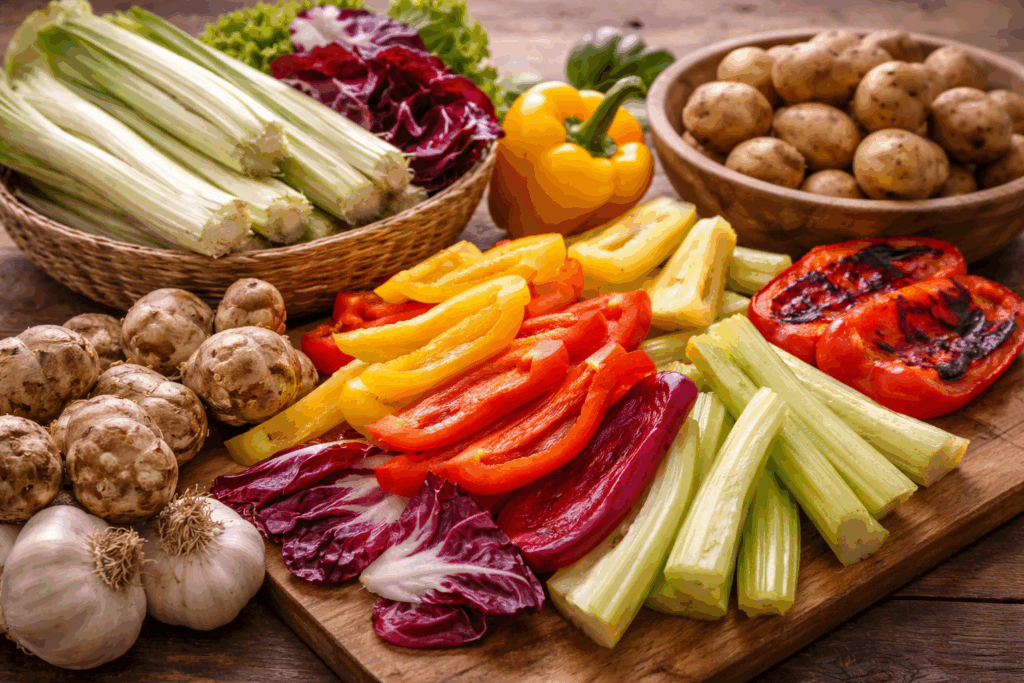
Cardoon, Jerusalem artichoke, pepper, potato.
Everything the land offers at that moment, without forcing.
Bagna caoda doesn’t cover these flavors.
It accompanies them.
It holds them together.
It’s a very simple balance, but precisely for this reason difficult to explain in words.
It must be experienced.
Faule: when an entire village gathers around bagna cauda
And then there are places where this feeling is even stronger.
One of these is Faule, a small town in the Cuneo plains where bagna cauda is not just tradition, but identity.
Here, every year, the Bagna Cauda Festival is held.
And it’s not one of those “passing through” festivals.
It’s something that involves not only the entire town but also many visitors from outside.
For days, kitchens light up, tables fill, and the numbers are almost smile-inducing: hundreds of kilos of anchovies, quintals of bagna cauda, thousands of people sitting together sharing the same gesture.
And in the midst of all this, that thing always remains:
time slowing down.
There’s also a special feature: bagna caoda has taken its own path here, softer, creamier, with milk and cream, so much so that it’s recognized as a traditional product of the area.
A way to handle such high attendance numbers, optimizing the work while still maintaining great flavor!
On the other side of the world: the bagna caoda that crossed the ocean
And then something even more surprising happens.
Bagna cauda departs.
And arrives far away.
With Piedmontese emigration in the 19th century, this dish crosses the ocean and takes root in Argentina, where it’s still deeply alive today.
In the provinces of Córdoba, Santa Fe, Buenos Aires… bagna cauda becomes a collective gathering, so much so that there are actual festivals dedicated to it, like the Fiesta Nacional della Bagna Cauda that draws thousands of people every year.
And there it changes slightly.
It transforms.
Often cream is added, it adapts to local products, but the meaning remains the same: being together around something warm, in winter, sharing a simple gesture.
And then you realize it’s not just a Piedmontese recipe.
It’s a language.
A dish that can’t be explained, only experienced
In the end, bagna cauda is this.
It’s not something you observe from the outside.
It’s something you enter into.
It’s the sound of cutlery stopping because someone is telling a story.
It’s bread passed from hand to hand.
It’s the brief silence between one sentence and another.
It’s a way of being together that today, perhaps, we’ve somewhat forgotten.
But it takes very little to rediscover.
And perhaps that’s exactly why it keeps coming back.
Year after year.
Table after table.
Because some things don’t need to be explained.
They need to be experienced.
Do you like Bagna Caoda? Let me know in the comments, if you’d like! See you in the next article!


