

This post is also available in:
There are territories that aren’t described by a list, but by layers. Places that don’t stay still within a single name, but expand, overlap, and speak to one another.
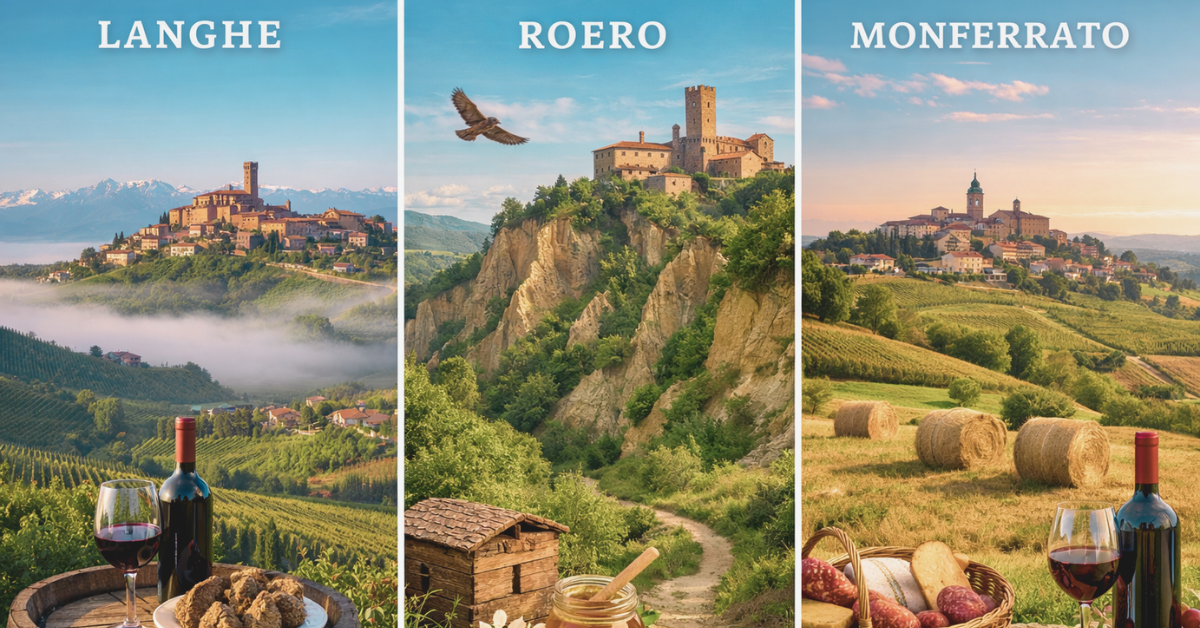
Langhe, Roero, and Monferrato are like this: three souls of a single landscape, three different ways of inhabiting the same sweetness of the Piedmontese hills.
So let’s take the time to cross them, one by one, as you do with things that truly matter.
Where Langhe, Roero, and Monferrato are located
We are in the heart of southern Piedmont, between the provinces of Cuneo, Asti, and Alessandria.
A vast but continuous territory, where hills follow one another without interruption, drawing a landscape that became a UNESCO World Heritage site in 2014.
Here, the land is not just a backdrop: it is the protagonist.
Every curve tells of a process, every row of vines follows a story, every village seems born to observe the passing of time.
The Langhe: elegance, depth, silence
The Langhe have something composed, almost austere.
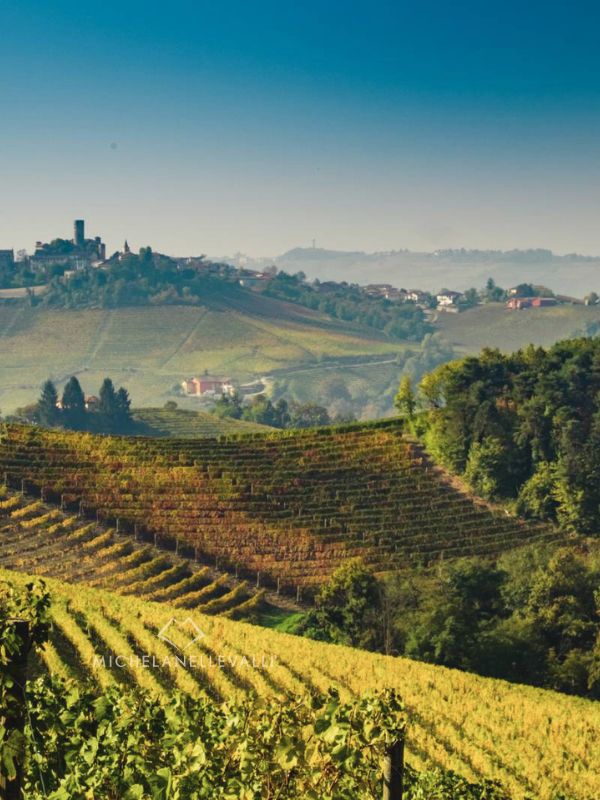
The hills are higher, more orderly, designed by precise rows that seem to trace an ancient script.
Here, wine is identity.
Barolo and Barbaresco are not simply wines: they are the expression of a land that has learned to speak slowly, through time and waiting. Alongside them, the Tonda Gentile hazelnut of the Langhe, the white truffle of Alba, and a gastronomic culture that doesn’t need to raise its voice.
Find the full article exploring the Langhe here
What to see in the Langhe
- Alba, elegant and lively, with its international flair
- Barolo, small and central, with its castle overlooking the vineyards
- La Morra, one of the widest viewpoints over the entire Langa
- The roads between the rows of vines, which are often the real experience
The Langhe are experienced like this: without haste, letting your gaze be the guide.
Fun fact: the bandits in the Langhe, in a time when this territory was something else entirely!
Roero: wilder nature, agricultural soul
Just cross the Tanaro and something changes.
The landscape becomes more irregular, more spontaneous, less “constructed.”
Roero is this: a land less talked about, but deeply authentic.
Here the Rocche del Roero appear—walls of sand and clay carved by time, breaking the sweetness of the hills with sudden cuts. It is a more vivid, more dynamic nature.
The products change tone, too.
The Roero Arneis, a fresh and fragrant white wine, tells of a different lightness compared to the structure of the Langhe. And then the Madernassa pear, the agricultural produce, a daily life still very much tied to the land.

What to see in Roero
- Canale, the living heart of the territory
- The Rocche, among trails and viewpoints
- The small villages scattered among the hills
- The roads less traveled, where the landscape suddenly opens up
Roero is a territory to discover without expectations, letting yourself be surprised.
Find the full article exploring Roero here
Monferrato: widespread sweetness and peasant memory
Monferrato is wider, more open, almost more human.
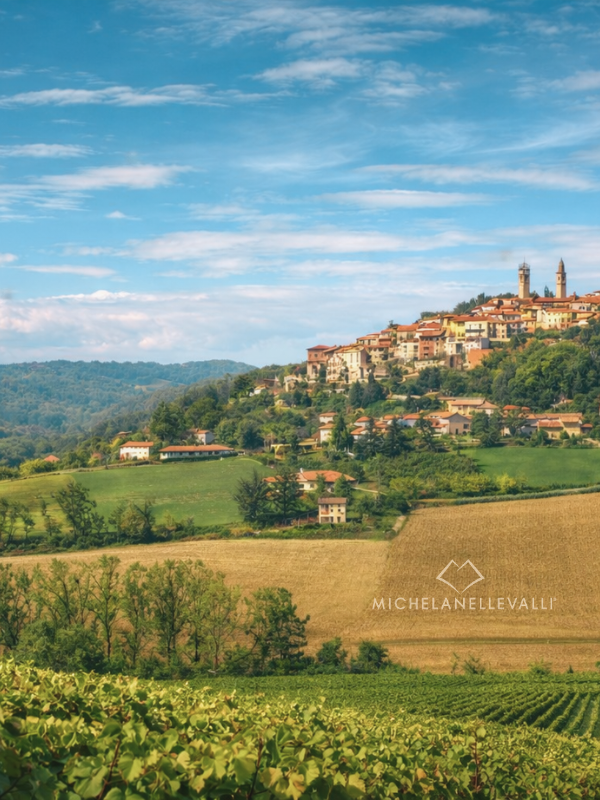
The hills stretch out, becoming softer, and the villages seem to settle in without needing to dominate.
It is a land that welcomes.
Here the wine changes again:
the Barbera, the Grignolino, the Brachetto d’Acqui, sweet and aromatic, tell of a more convivial, more immediate tradition.
But Monferrato is also peasant history, infernot cellars carved into the stone, family vineyards, gestures repeated for generations.
What to see in Monferrato
- Acqui Terme, with its waters and its history
- The villages spread between Asti and Alessandria
- The UNESCO heritage hills, softer and more accessible
- The small towns, where time seems to truly slow down
Monferrato doesn’t impose itself: it accompanies you.
Find the full article dedicated to Monferrato here
Three territories, three identities
Langhe, Roero, and Monferrato are not variations of the same landscape.
They are three different ways of living the land.
- The Langhe are structure, elegance, depth
- Roero is movement, nature, authenticity
- Monferrato is hospitality, memory, daily life
And perhaps their greatest value lies right here:
in the fact that, despite being so close, they manage to remain distinct, each with its own voice.

A territory to travel through, not to consume
These hills don’t ask to be visited quickly.
They ask for presence.
They ask you to stop on a bench for no particular reason,
to follow a road even if it doesn’t lead to a marked point on the map,
to listen to what happens when nothing is happening.
Because it is there, in that apparent void, that these territories truly begin to speak.
And when they do, they are hard to forget.


