

This post is also available in:
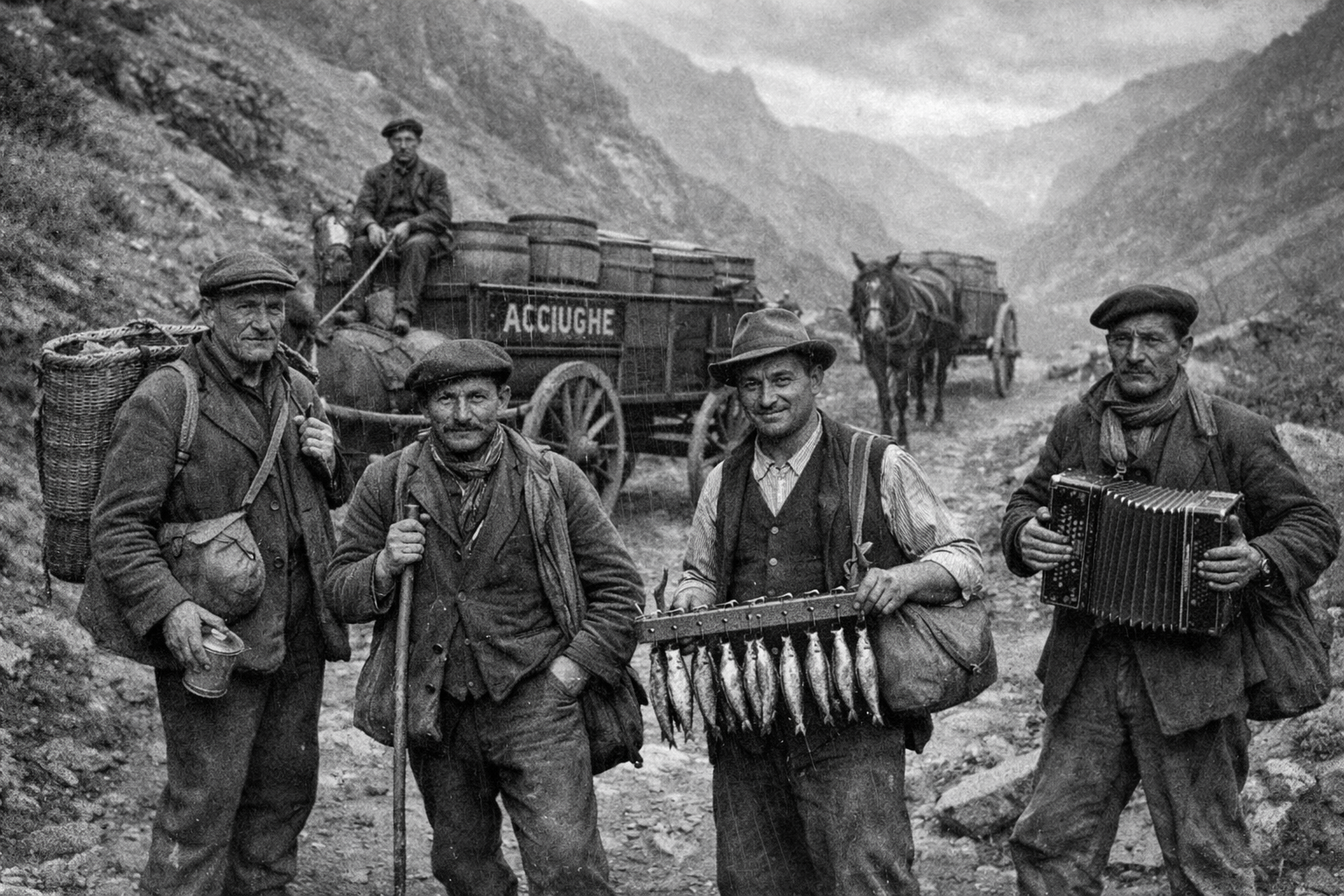
There are stories that make no noise, but cross the mountains like a slow wind, carrying scents, gestures, and entire lives with them.
And the story of the anchovy sellers is one of these.
Who Were the Anchovy Sellers
In the valleys of the Cuneo area, especially in Valle Maira, this trade didn’t arise by chance, but out of necessity.
Here, where winter is long and the land doesn’t always provide enough, families needed something more to get through the months when farming stopped.
And it’s precisely from this need that one of the most fascinating stories of the territory takes shape.
The men would leave.
They’d abandon the hamlets, the stone houses, and set out on foot.
Not to travel, but to find a way to stay.
From Mountains to Sea (and Back)
At first they weren’t anchovy sellers, but salt traders.
A precious commodity, necessary, but burdened by very high taxes.
And then something ingenious happens, almost silently revolutionary.
To bypass the controls, they started covering the salt with a layer of anchovies.
A simple trick, but effective: at customs they saw fish, not salt.
And there, in that clever gesture, everything begins.
Because at a certain point they realize it’s not just a way to transport salt.
It’s a market.
So they start to change direction.
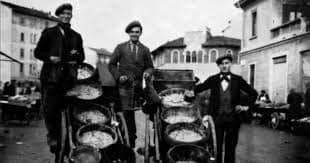
The anchovies were purchased along the Ligurian coast—especially between the ports of Imperia and Genoa—and then transported on foot, or by cart, crossing the Alpine passes.
A long, tiring journey, along that famous Via del Sale that you can still walk today.
The anchovies become trade goods, but also a bond between territories.
Watch my video story about the History of Anchovies along the Via del Sale here!
The Blue Carts and the Roads of Memory
Those who saw them tell of carts painted blue.
A color you could recognize from afar, almost like a signature.
Loaded carts, heavy, but orderly.
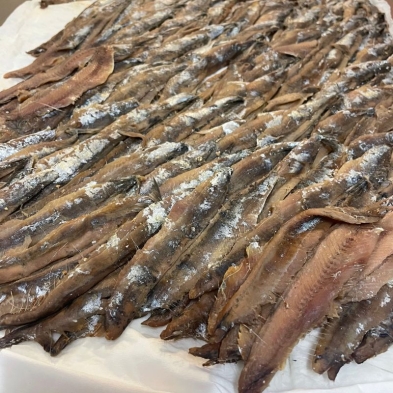
Inside: barrels, salted anchovies, work tools.
Outside: the dust of the roads, time, and the dignity of those who walked out of necessity, not choice.
The anchovy sellers weren’t just traders.
They were experts of the roads, the seasons, the people.
They entered villages, inns, kitchens.
And slowly, without knowing it, they also brought a piece of the sea into the mountains.
A Trade That Also Changed the Table
Because without them, many traditions wouldn’t have reached us.
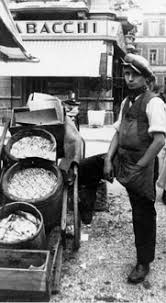
Bagna Cauda, for example, was born precisely from this meeting of worlds:
anchovies from the sea and garlic, oil, the land of Piedmont.
A humble dish, yes, but deeply rooted in identity.
👉 If you want to dive deep into this story, here’s my article dedicated to Bagna Cauda
👉 And here you can watch the video where I tell the stories connected to anchovies and those who brought them all the way up here
The Fairs and Living Memory
Even today, this story hasn’t remained locked in books.
Every year, in Dronero, the Anchovy Sellers’ Fair is held.
A moment that’s not just celebration, but shared memory.
The journeys are remembered, the names, the families.
Those ancient gestures that built an identity are brought back to center stage.
Trades Born from Scarcity (That Become Culture)
The anchovy sellers’ story isn’t an isolated case.
In these valleys, necessity has often sparked ingenuity.
As happened in Elva, with the hair traders, another incredible trade born to survive, and then became part of local history.
👉 If you want to discover this story too, here’s the dedicated article
Perfect, this is exactly the kind of addition that enriches the article and makes it even more concrete, more “walkable.”
I’ll rewrite the section for you, integrating the real references you gave me as well, keeping your tone.
Where to Find the Anchovy Sellers Today
The Anchovy Sellers Museum
There are places, in the valley, where this story isn’t just told.
It’s still resting there, among the stones, in the walls, in the gestures.
In Celle di Macra, in the Chiesa hamlet, there’s the Museo Seles – Museum of Anchovy Sellers and Itinerant Trades.
It’s housed inside an old chapel, and that alone says a lot: it’s not a space built to display, but to preserve.
Inside you’ll find clothing, tools, documents, but above all, lives.
A journey that tells how this trade, born as seasonal work, became over the years a true identity of the valley, involving entire hamlets like Macra, Lottulo, and Paglieres.
The Anchovy Sellers Trail
And then, right from there, the Anchovy Sellers Trail begins.
A simple, accessible path, but full of meaning.
It winds through the hamlets of Celle, passing by the homes of those who truly lived this trade—and in some cases still live it today, at markets in northern Italy.
Walking, you encounter the traces of a slow migration:
gentle climbs, open plateaus, woods, and then houses again.
It’s a loop of about 6.5 km that tells not just a trade, but a way of being in the world.
Here the anchovy sellers haven’t become a distant memory to observe from afar.
They’re still part of the landscape.
You find them in the trails, in the stories, in the families.
And in that invisible thread that continues to hold the sea and the mountains together.
A Thread That Continues
Today the anchovy sellers no longer set out on foot, and those blue carts no longer cross the passes as they once did.
But something has remained.
It remains in the way certain recipes still exist.
In the fact that, even here, far from the sea, the sea is present.
It remains in the stories that continue to pass from voice to voice.
And perhaps, every time we open a jar of anchovies, without knowing it, we’re still following those roads.


